Futureproofed Workshop #26: Workplace Rights with RhED and Southside Justice
Work in an establishment? You're entitled to workplace rights, just like any other workplace

Please note this advice is not intended to be a substitute for professional legal advice. Always seek the guidance of a qualified legal professional with any questions you may have regarding your legal rights or obligations.

Sex Industry Venues
Sex industry workplaces are incredibly varied. Some venues are great places to work, and some, not so much. One workplace might be good for one person and not for someone else.
All employers have legal responsibilities to keep employees and others safe and healthy in the workplace.
Challenges
Stigma is the main barrier preventing workers from following up workplace issues.
Sometimes, we want to protect our peers from exposure to authorities and regulatory bodies, so we avoid reporting issues to people who have power to improve workplace conditions.
Other barriers include:
Possible workplace retaliation, such as being fired or not full rostered.
Concerns around visa and tax status.
Lack of knowledge of processes for following up issues.
Concerns around privacy and confidentiality.
Who are the regulators?
WorkSafe Victoria
Fair Work Ombudsman
Victorian Equal Opportunity and Human Rights Commission
Fair Work Commission
Victoria Police
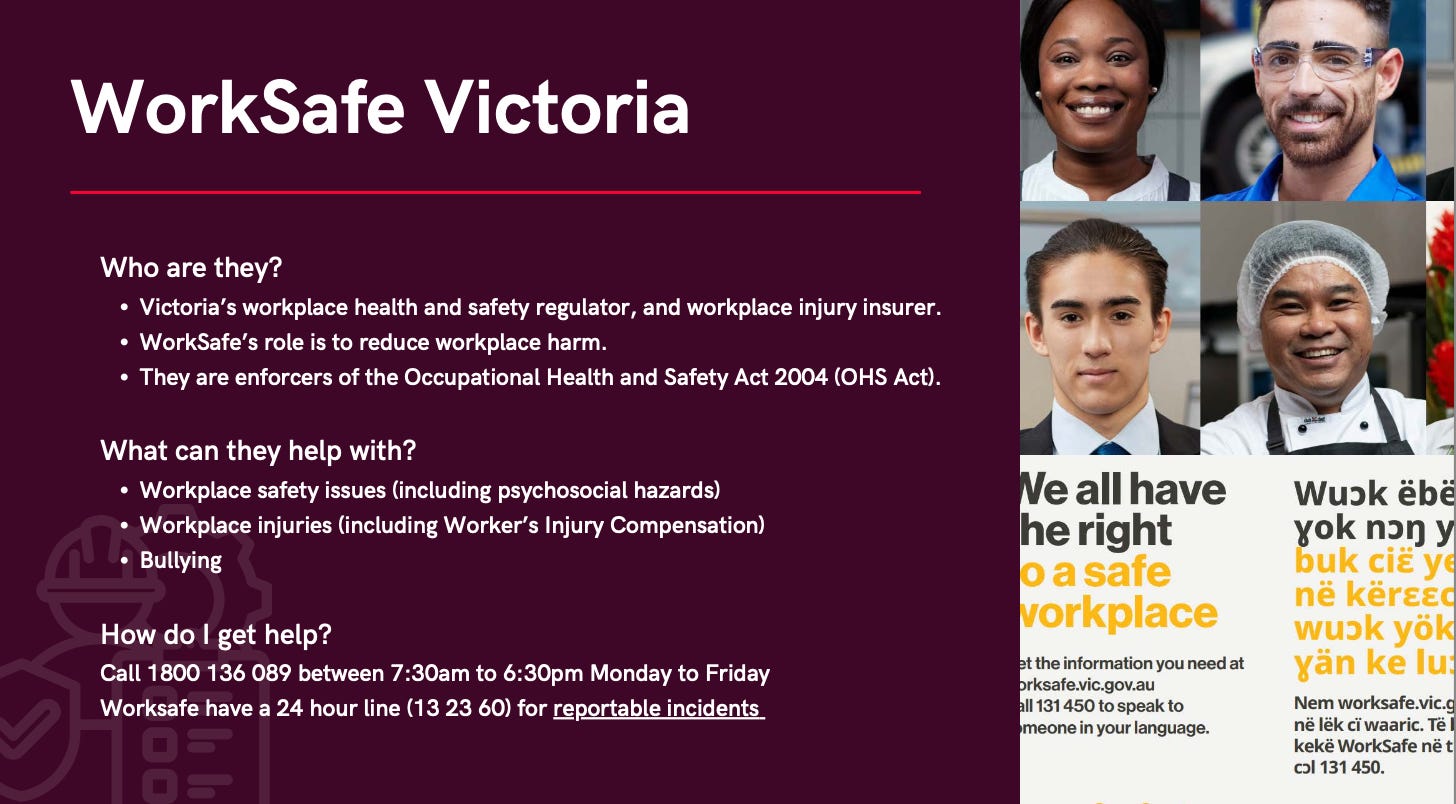
WorkSafe Victoria
Who are they?
Victoria’s workplace health and safety regulator, and workplace injury insurer.
WorkSafe’s role is to reduce workplace harm.
They are enforcers of the Occupational Health and Safety Act 2004 (OHS Act).
What can they help with?
Workplace safety issues including psychosocial hazards.
Workplace injuries including worker’s injury compensation.
Bullying.
How do I get help?
Call 1800 136 089 between 7:30am to 6:30pm Monday to Friday.
Worksafe have a 24-hour line (13 23 60) for reportable incidents.
Victoria Police
Who are they?
Victoria Police have powers to execute functions within legislation that is designed to protect and service the community. Victoria police enforce legislative acts such as the Crimes Act and have powers greater than that of an everyday citizen.
What can they help with?
Criminal offences such as harassment, stalking, sexual assault, and theft.
How do I get help?
Emergency: 000
General Assistance Line: 131 444
Fair Work Commission
Who are they?
Australia’s national workplace relations tribunal and registered organisation's regulator.
What can they help with?
Disputes in the workplace such as:
Dismissal
Bullying and harassment
Unfair terms in services contracts (new function)
How do I get help?
You will need to visit this page for information on how to lodge a claim. If you lodge a claim with the Fair Work Commission, you are starting a legal process.
Fair Work Ombudsman
Who are they?
The national workplace relations regulator.
Enforce compliance with the fair Work Act, related legislation, awards, and registered agreements.
What can they help with?
Educate employees about pay, workplace entitlements, workplace protections, and starting/ending employment.
Investigate breaches of the Fair Work Act (and recover underpayment).
How do I get help?
Call 13 13 94 between 8am – 5:30pm Monday to Friday to speak with an adviser or submit an online enquiry.
Victorian Equal Opportunity and Human Rights Commission
Who are they?
A statutory authority whose role is to protect and promote human rights in Victoria. VEOHRC is an independent body with responsibilities under Victoria’s Human Rights laws.
What can they help with?
Discrimination, sexual harassment, victimisation, racial or religious
vilification, or change or suppression practices.
How do I get help?
Call 1300 292 153 – weekdays from 10am–2pm
Send an email to complaints@veohrc.vic.gov.au with your issue.
VEOHRC can hear complaints of discrimination against sex workers in the provision of accomodation, goods and services, education, employment and clubs or sport.
For example, your rental provider can’t ask you to leave because of your job as a sex worker; your bank can’t refuse services because of your job as a sex worker.
VEOHRC assesses complaints and either accepts a complaint for conciliation or dismisses a complaint.
VEOHRC hosts the conciliation, provides a conciliator and cannot favour either side. This process is free. If parties don’t agree, you can apply to VCAT and a Tribunal Member will decide.
How do you learn if you’re an employee or a contractor?
It depends on individual circumstances and often is decided by courts or other regulatory bodies.
The whole of relationship test is used in some contexts to determine if someone is an employee or contractor.
This test considers:
Is there a written agreement?
If so, does it reflect what happens in practice?
Which party has the balance of control over how work is performed?
Financial responsibility and risk in the business.
Tools and equipment.
Goodwill in business.
Ability to delegate or subcontract work.
Hours of work.
Is there an expectation of work continuing?
What is sham contracting?
Sham contracting is when someone is treated as a contractor, when they are actually working under employee like conditions. It is illegal.
A business may illegally misrepresent an employee as a contractor to avoid obligations such as superannuation, leave entitlements, and other responsibilities.
If you have concerns you are in a sham contracting arrangement, can seek guidance from the Fair Work Ombudsman. You may need to seek legal advice and can seek free, confidential legal advice from Southside Justice’s Sex Worker Legal Program.
Am I an employee or contractor?
Example: “In Helft V Top of the Town (2022) FWC 2656, the Fair Work Commission determined that a sex worker, was an independent contractor in the work she undertook at the adult services venue Top of the Town.”
Just because this was the determination in this case, doesn’t mean your relationship with your employer would be assessed the same.
What was this finding based on?
No financial relationship between worker and workplace.
Worker had paid high level of control over work such as hours etc.
Worker had right to refuse services to client.
In some instances, such as WorkCover claims, it is only necessary to establish you were a ‘worker’ under the Workplace Injury Rehabilitation and Compensation Act 2013.
Sex workers in Victoria have successfully received WorkCover compensation for workplace injuries by establishing they are workers under the Act.
To establish this, it’s best to have evidence such as a contract, communication from work, etc. Try to start collecting this information before you need it!
My venue has fired or full-rostered me, what can I do?
Unfortunately, as most sex workers are contractors, there is little job security. Workplaces can decide to stop giving contractors shifts at any time and there is usually no recourse regarding unfair dismissal.
However, if you have been bullied or discriminated against you can follow this up with the VEOHRC (discrimination) or the Fair Work Commission (bullying).
If you think you are in a sham contracting arrangement and you do have a claim to unfair dismissal, you can contact the Fair Work Ombudsman.
You can also seek free, confidential legal advice from Southside Justice’s Sex Worker Legal Program.
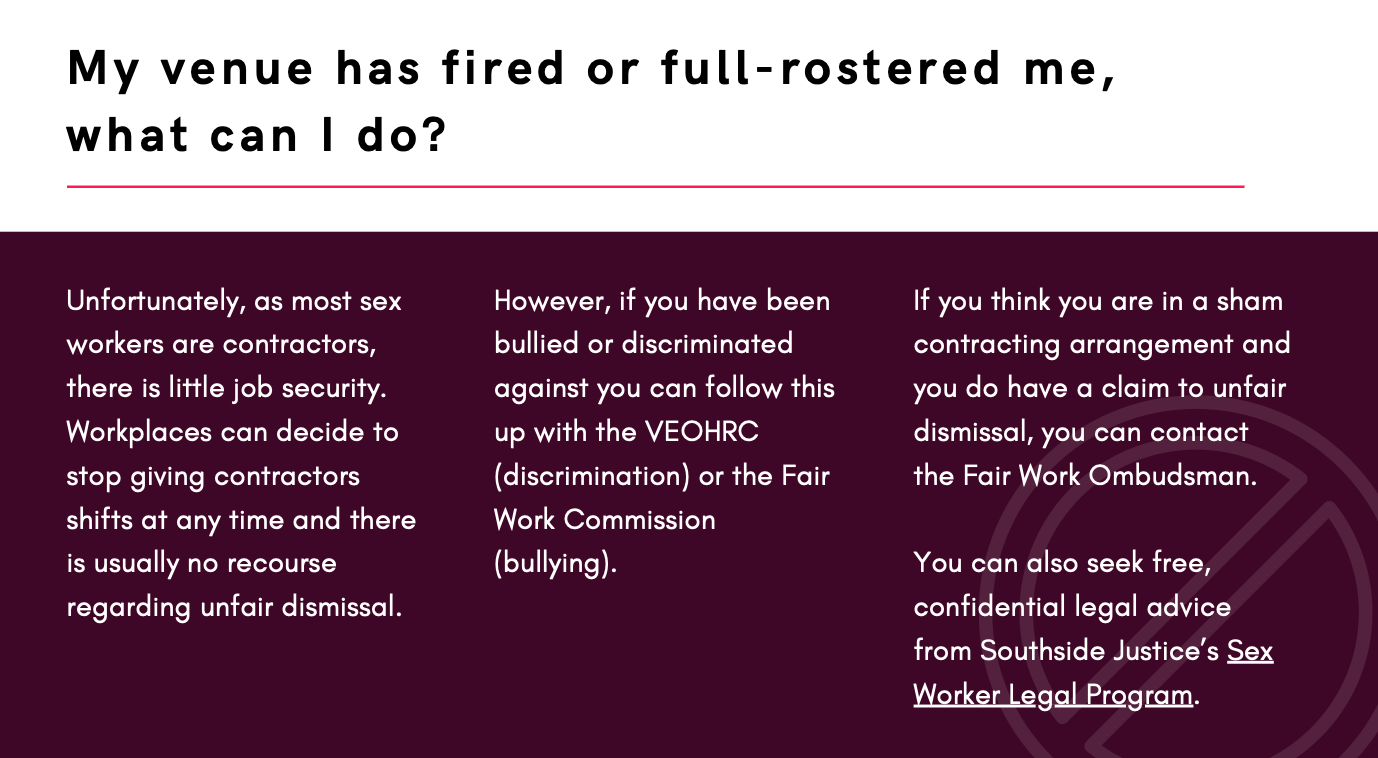
What do I do if my workplace has any type of hazard?
Hazards can be:
Lack of panic buttons
Trip hazards
Mould in the rooms
Uneven stairs
No showers
A faulty stage floor
No break room
Any other type of hazard
You could:
Talk to management (alone or in a group).
Contact WorkSafe if nothing is done to address your concerns.
You can remain anonymous when making a report to WorkSafe.
Weigh up pros and cons for you:
What would happen if your workplace suspected you made the report?
A report may lead to WorkSafe attending your workplace without warning.
You might feel that venues not providing safe workplaces should be held to account.
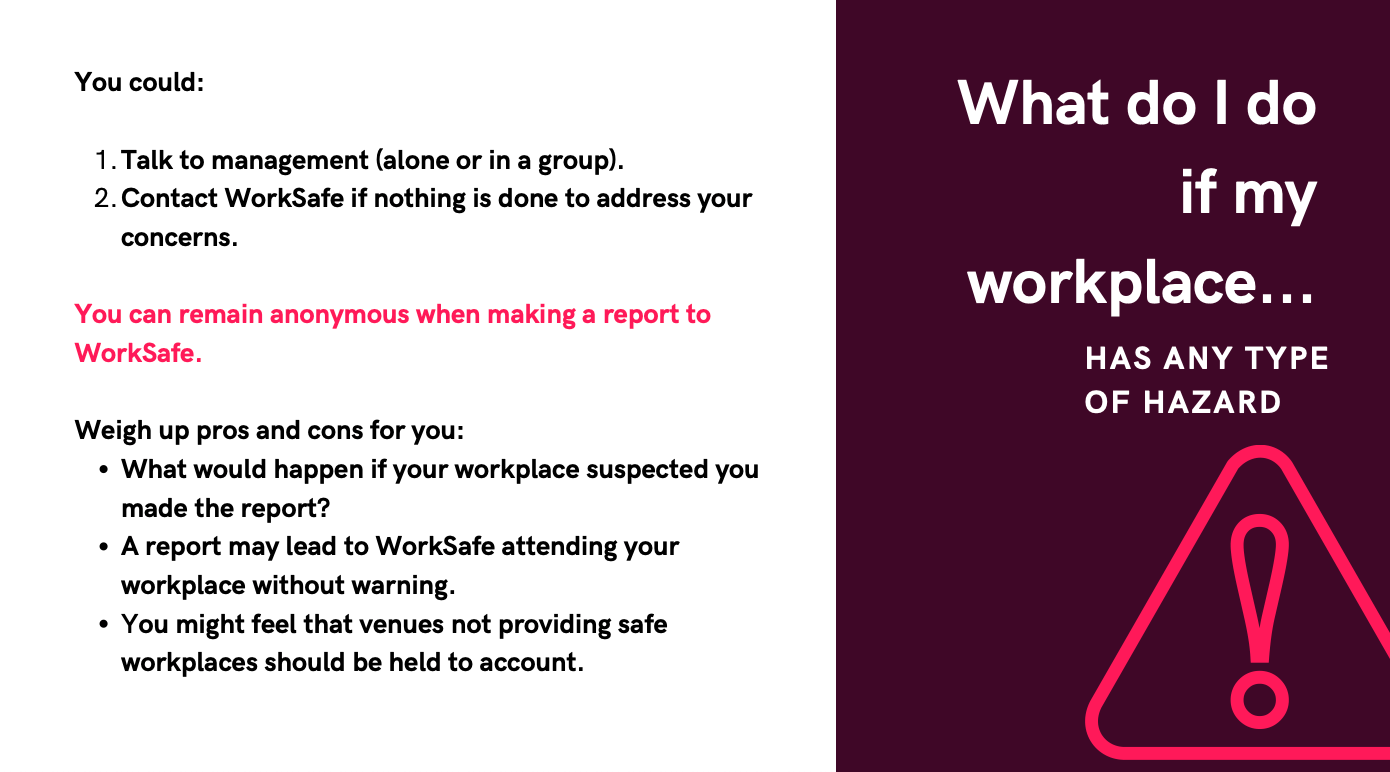
Safe For Work
WorkSafe’s new resource for sex workers. It can be accessed online on WorkSafe’s website. There are limited hardcopies available also.
This resource has answers to questions from sex workers regarding OHS and contacting WorkSafe, as well as other important information.
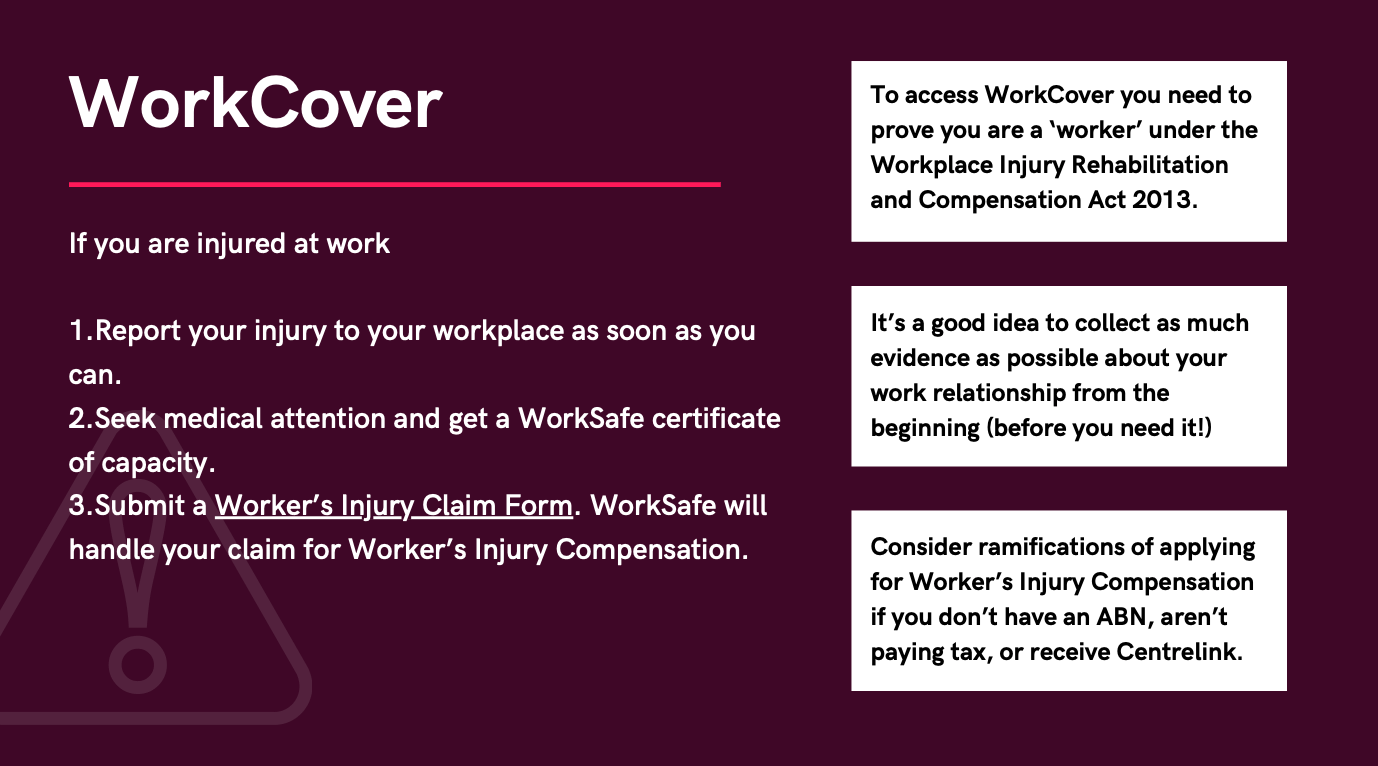
Workcover
If you are injured at work:
Report your injury to your workplace as soon as you can.
Seek a medical attention and get a WorkSafe certificate of capacity.
Submit a Worker’s Injury Claim Form. WorkSafe will handle your claim for Worker’s Injury Compensation.
To access WorkCover you need to prove you are a ‘worker’ under Workplace Injury Rehabilitation and Compensation Act 2013.
It’s a good idea to collect as much evidence as possible about your work relationship from the beginning (before you need it).
Consider ramifications of applying for Worker’s Injury Compensation for Worker’s Injury Compensation if you don’t have an ABN, aren’t paying tax or receive Centrelink.
What can I do if my workplace lets known problematic clients in?
Workplaces have obligations under Victorian occupational health and safety legislation to provide a safe environment for workers (including contractors).
Occupational violence and aggression is a workplace hazard that should be eliminated or controlled as per OH&S legislation.
If your workplace lets known problematic clients into the venue, you can advise WorkSafe of your concerns that your workplace is failing to keep up with their OH&S obligations.
Police have a role to play in situations where clients are being violent or aggressive. Regardless of your workplace response to a client, you are able to report violent and aggressive client’s to police either while the client is acting aggressively or after the situation has resolved.
Also, if your manager knowingly books you for a service you don’t provide, that may amount to sexual harassment in the workplace: unwelcome and unwanted conduct of a sexual nature. Get legal advice.
What if my venue wants me to return a client’s money when I cancelled the booking due to their poor behaviour?
As a sole contractor, a venue cannot intervene in payments between you and a client. A venue has the option to refund the money they have received from the client for room hire, but they cannot make you return your cut of payment from the client.
Additionally, if a client has acted in a dangerous, criminal, or violent way towards you, a venue should record this incident and look at ways they could reduce an incident like this happening in the future.
You can report a client to police for criminal behaviour. It may not lead to an arrest depending on the level of evidence, however even if it doesn’t, it may help in arresting a client who is a serial offender.
My venue is telling me what I can and can’t charge for different services I am providing.
As a sole contractor, a venue cannot tell you what services to provide, or how much you can charge for them.
Unfortunately, a venue can decide to give shifts to workers who provide the services they want them to and who charge the amount of money that aligns with what they want workers to charge.
The more control a workplace has over how you conduct your business, the more likely they will decide you are in a employee/employer relationship.
My venue is telling me what I have to include in my services.
As a contractor you are able to decide how your work is conducted. Telling a worker they ‘must’ provide certain sexual services may be sexual harassment.
The more control a workplace has over how you conduct your business, the more likely a court will decide you are in a employee/employer relationship.
Workplace Organising
Getting together with others in your workplace to discuss issues in the workplace, and possible ways to address them.
Be aware that while there is often strength in numbers, venues may have been known to fire groups of workers who raise concerns with management.
What can I do if a client doesn’t pay me?
Not paying a sex worker for services provided is sexual assault under Victorian law. If this happens to you, you can:
Report the crime to police (to your local SOCIT team, not whoever is on duty at your local station.) RhED can support you in this process.
Seek support from Southside Justice’s Sex Worker Legal Program. A lawyer may be able to send a letter of demand to the client in an attempt to recover the money.
If they don’t pay you in response to the letter of demand, you can get support applying to VCAT’s Goods and Services list to recover the unpaid contract amount.
NOTE: You must have the legal name and an address for service (email is ok) to send the letter of demand and serve any application to VCAT. Without contact details, a police report is the only option.
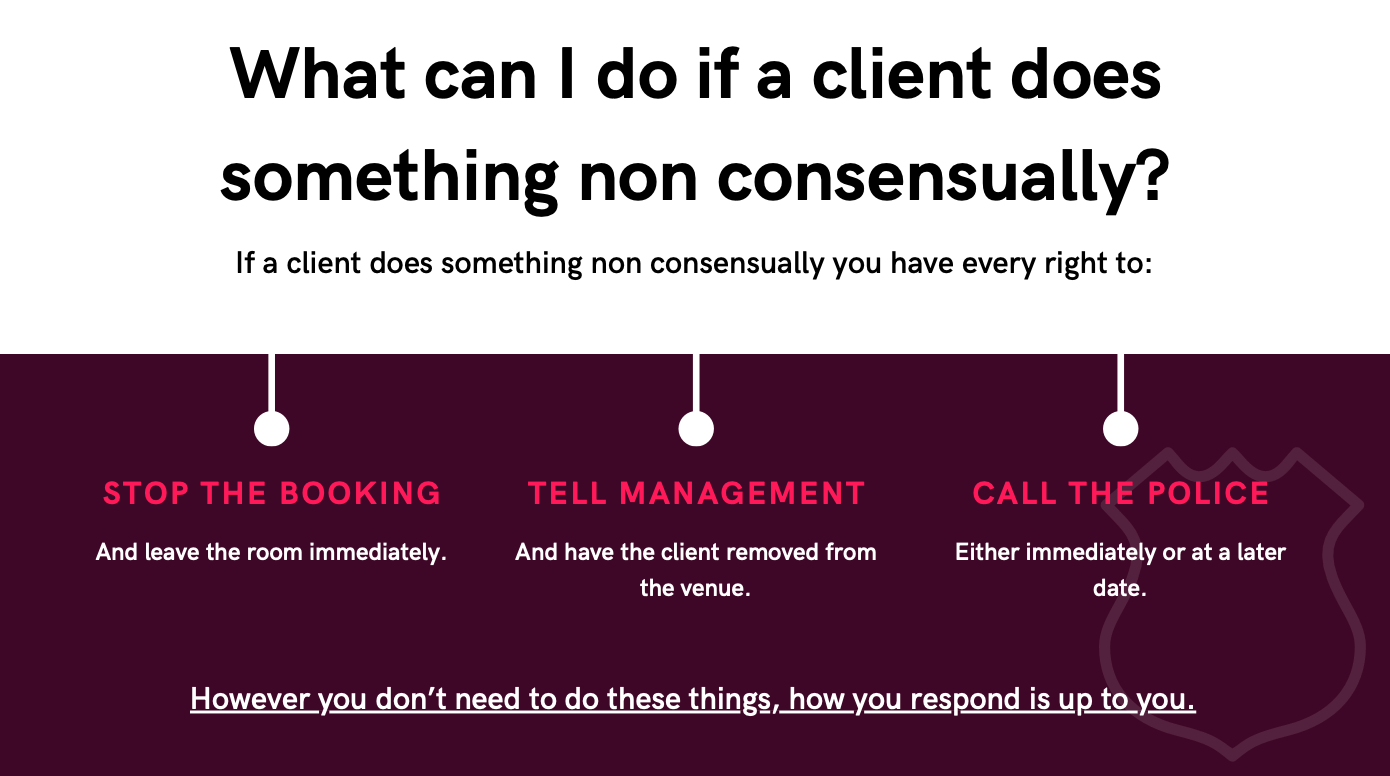
What can I do if a client does something non consensually?
If a client does something non-consensually you have every right to:
Stop the booking and leave the room immediately.
Tell management and have the client removed from the venue.
Call the police - either immediately or at a later date.
However you don’t need to do these things, how you respond is up to you.
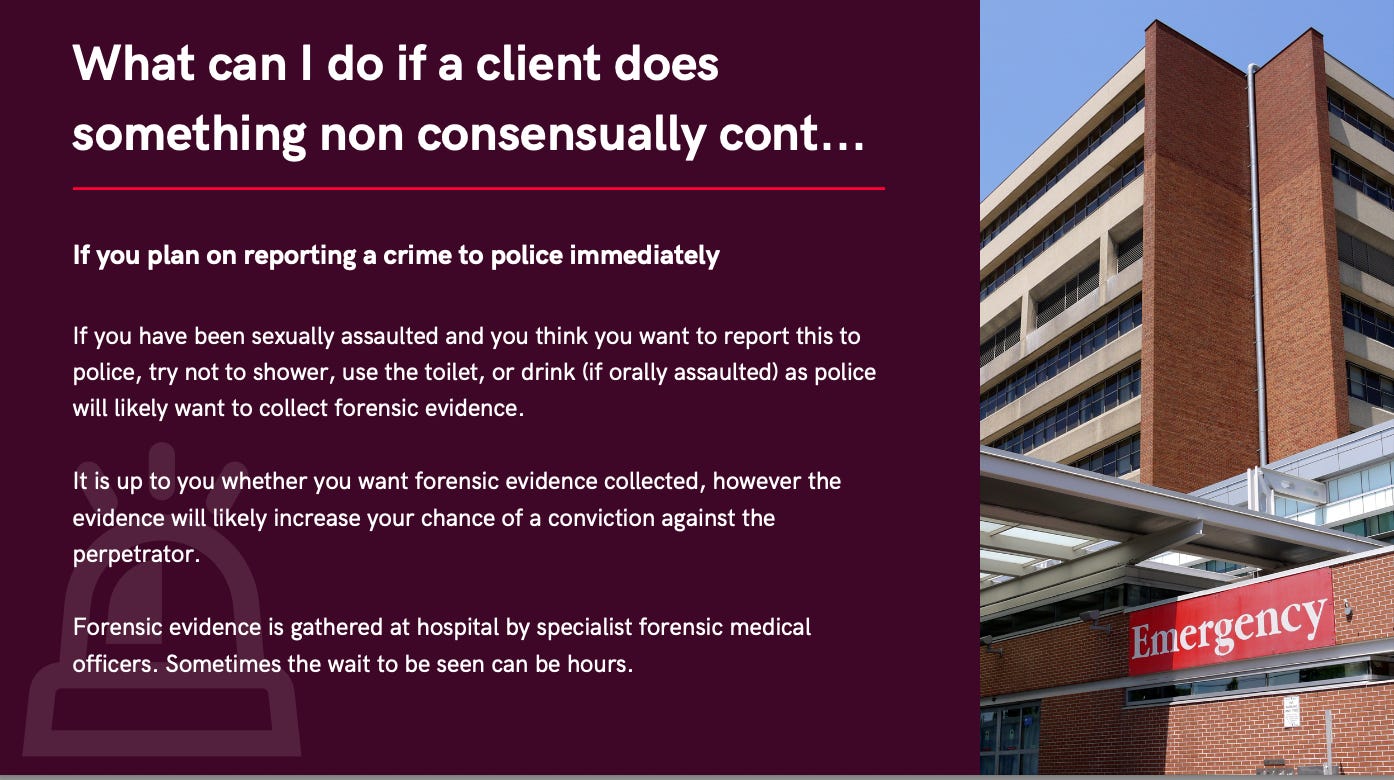
If you plan on reporting a crime to police immediately
If you have been sexually assaulted and you think you want to report this to police, try not to shower, use the toilet, or drink (if orally assaulted) as police will likely want to collect forensic evidence.
It is up to you whether you want forensic evidence collected, however the evidence will likely increase your chance of a conviction against the perpetrator.
Forensic evidence is gathered at hospital by specialist forensic medical officers. Sometimes the wait to be seen can be hours.
Where else can I find support?
CASA: Centre against Sexual Assault
You can access 24hr crisis support through CASA by calling 1800 806 292.
Peer Debriefing
From Vixen, RhED, or other sex worker groups and spaces.
Peruse the RhED resource on returning to work after sexual assault here:

Ongoing Counselling
RhED has referral lists for sex worker allied mental health supports.

What should I expect if I decide to report a crime to police?
1. When you call the police, they will arrange a time to speak with you at a station. This will likely be an initial discussion of what happened and not a formal interview/statement.
Police will consider what crimes have been committed and then organise a time for a formal interview/statement.
2. When you attend to take your statement, it might take hours, or even a few sessions. You can ask the police what to expect.
Police will have to ask you very specific details for their investigation.
You can have a support person with you however police usually prefer them to not sit in on the statement (they prefer them to sit in a seperate room).
3. When you report a crime to police, they must undertake a full investigation to get any sort of outcome for you e.g in instances of non-payment, police can’t just try to recover payment for you, they must conduct a full sexual assault investigation.
Investigations are often slow and can take years from beginning to outcome, and sometimes the outcome may not be what you are hoping for.
You can find more information in the Reporting Sexual Offences PDF.

You can cease your involvement with police at anytime. Police may proceed with prosecuting a case however without your involvement. You can report a crime to police no matter how long it has been since the crime occurred.
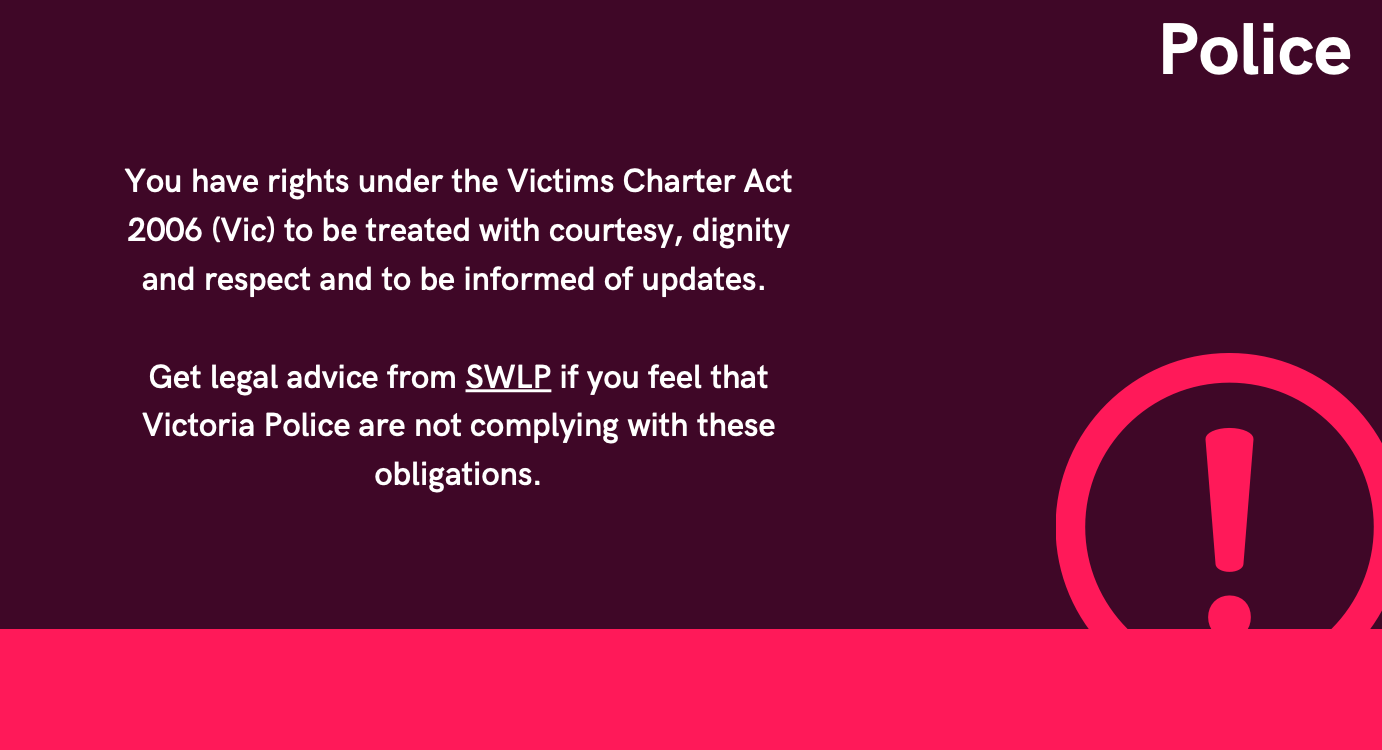
IMPORTANT
If you’ve experienced a sexual offence, it is best to report the crime to your local SOCIT (Sexual Offences and Child Abuse Investigation Team). They are specialised detectives who have more experience supporting people following a sexual offence (including sex workers).

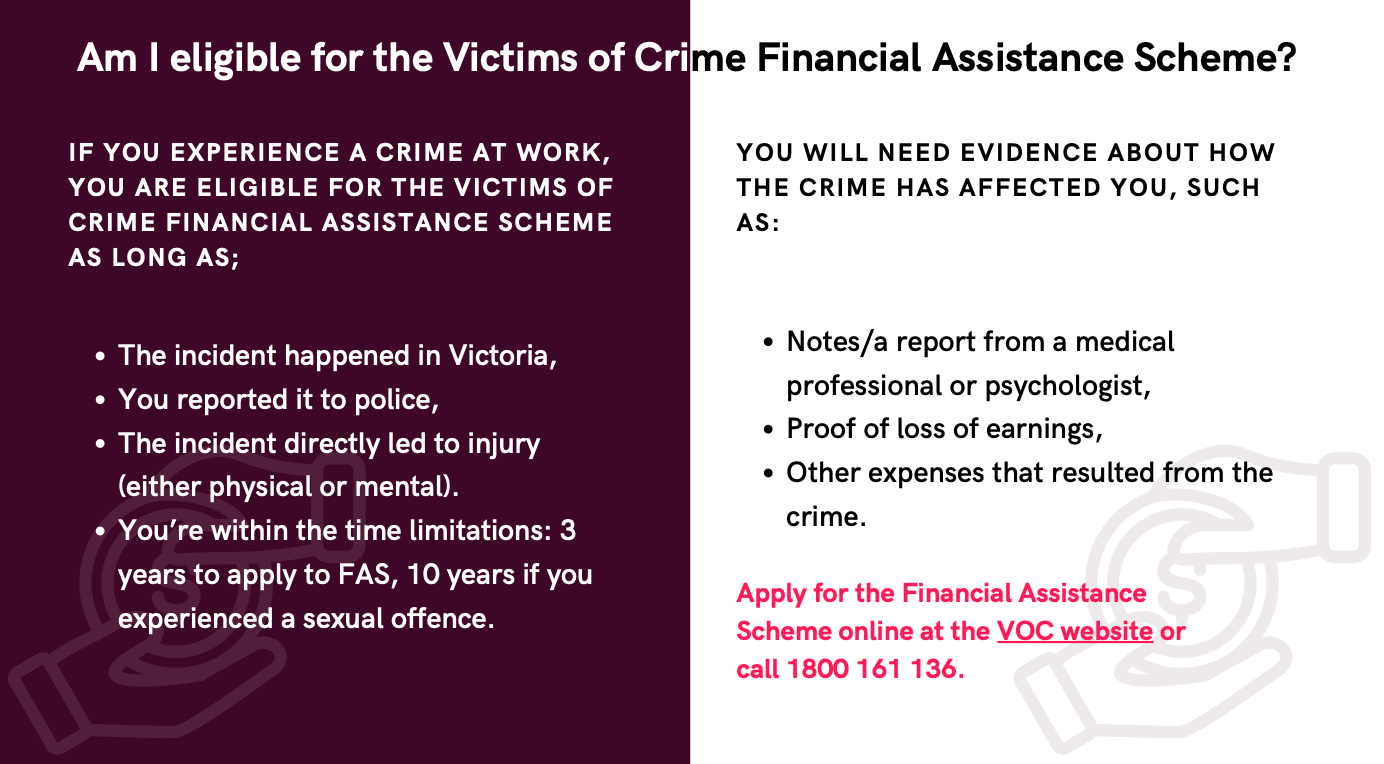
Am I eligible for the Victims of Crime Financial Assistance Scheme?
If you experience a crime at work, you are eligible for the victims of crime financial assistance scheme as long as:
The incident happened in Victoria
You reported it to the police
The incident directly led to injury (either physical or mental).
You’re within the time limitations: 3 years to apply to FAS, 10 years if you experienced a sexual offence.
You will need evidence about how the crime has affected you, such as:
Notes/a report from a medical professional or psychologist
Proof of loss of earnings
Other expenses that resulted from the crime.
Apply for Financial Assistance Scheme online at the VOC website or call 1800 161 136.
What if there is an incident at my work and I don’t want to report it through a government body?
That’s completely understandable! Many workers don’t want to report workplace incidents to external bodies. Think about what is most healing for you and what justice looks like.
Do you want to tell the sex work community about what happened - are you in private SW groups you can post in?
Do you want your workplace to take action to prevent this happening again?
Do you want your workplace to take action to prevent this happening again?
You can contact RhED or Vixen to discuss the incident and ways to achieve justice for you.

About our presenters RhED and Southside Justice.
RhED
Resourcing Health and Education in the sex industry (RhED) is a program that supports sex workers and the broader industry. RhED provides holistic and inclusive services, programmes and resources to Victorian-based sex workers, disseminate relevant and current information to the greater sex industry, and to provide sex-work-centred education to the wider community.
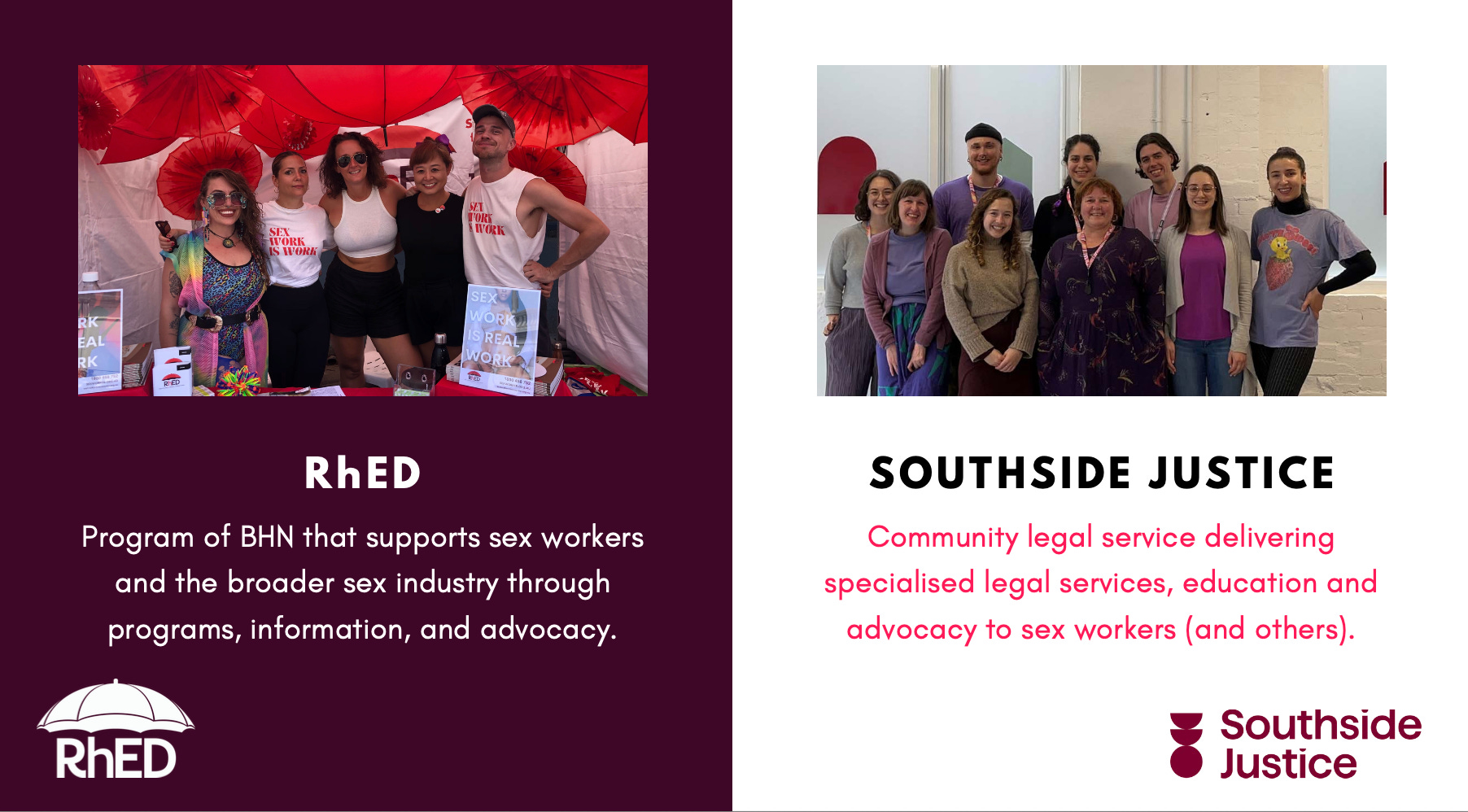

Southside Justice
Southside Justice has worked with the sex worker community for decades to support the advancement of sex worker rights and safety. The Sex Worker Legal Program offers free legal advice to all sex workers in Victoria and ongoing assistance to those who need it most. We deliver specialised legal services, education and advocacy to move towards a fair, safe and accessible justice system for sex workers that respects and upholds their human rights.

You can contact Southside Justice here.